Who Made the Japan in a Meiji Photograph Album?
A studio name can outlive the making of a negative. Read colour, staging and an album’s surviving container as different kinds of evidence.
Color was another act of making
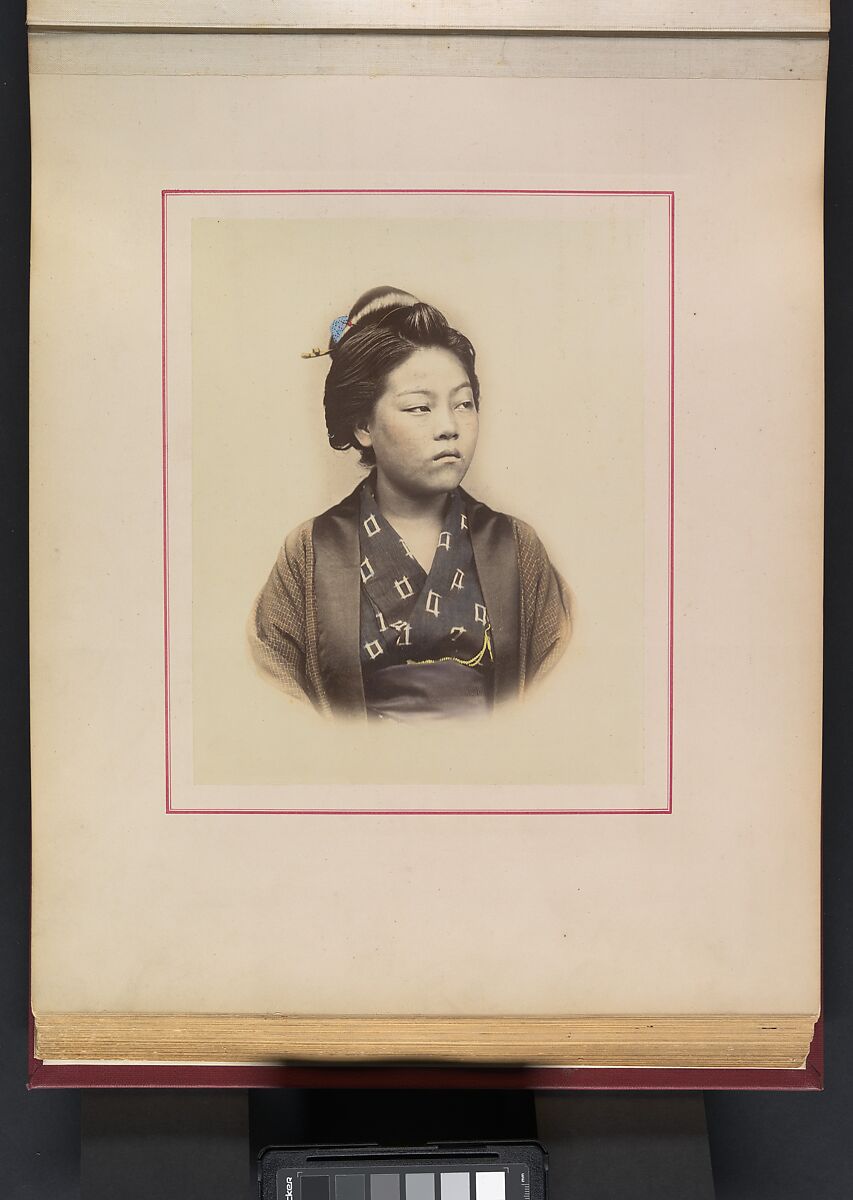
The color in a Meiji-era photograph album can look like direct evidence of a vanished world. Kobe City Museum’s exhibition explains a further act of production: color was applied individually to monochrome photographs. Studios assembled these images into elaborate albums for overseas visitors. Painting, selection and presentation helped shape the Japan a purchaser encountered. Kobe City Museum: Colorful JAPAN
The museum describes Kusakabe Kinbei’s GENERAL as a staged photograph of a costumed subject, with unusually elaborate clothing and carefully painted details. This particular example invites a question about the applied color: what does it emphasize? It does not justify assuming that every album scene was invented. Separate what the camera recorded from the work performed on the resulting print. Kobe City Museum: Colorful JAPAN
A studio name is not the whole authorship history
MIT’s Visualizing Cultures study of a Beato album explains how negatives continued to circulate. Stillfried printed Beato’s negatives and sold the images under Stillfried and Anderson’s name. The study describes later production under other photographers’ names, including Kusakabe Kimbei. It explicitly notes the difficulty of distinguishing original photographers when prints carry a later studio’s embossed name. MIT Visualizing Cultures: Felice Beato’s Japan: People
That account supports a limited conclusion: the studio named on a print or album need not identify who originally operated the camera. Exposure, printing, coloring and compilation should be separate questions in your notes. It does not establish the contents or authorship of every album connected with those studios. Leave an individual image’s maker unresolved when its own record supplies no answer. MIT Visualizing Cultures: Felice Beato’s Japan: People
A camera’s witness could enter the scene
The Getty’s account of Beato’s work describes his 1863 photograph of the Great Buddha at Kamakura. Beato posed on the steps while local men climbed the statue. The monument was real, but the photographer’s presence makes the arrangement of people part of the evidence. A carefully composed view is different from an unplanned glimpse. J. Paul Getty Museum: Felice Beato: A Photographer on the Eastern Road
The Getty also explains that Beato’s photographs continued circulating after he left Japan as his negatives passed to other studios. This separates two histories: the making of a scene and the later production of prints. For an album page, ask which moment a supplied date describes. Do not silently treat an exposure date as the date that every surviving print or album was assembled. J. Paul Getty Museum: Felice Beato: A Photographer on the Eastern Road
Read the container as evidence too
Duke University Libraries’ conservator Henry Hebert documented a late nineteenth-century Japanese photograph album and the decorative box in which it was originally bought and stored. The box contained an interior label useful for researching the album’s history. His account explains a decision to house the heavy album separately and stabilize the original enclosure so researchers could consult its interior label. Duke University Libraries: Preservation Nesting Boxes
The label and the photograph answer different questions. When a catalogue records a studio address or an original container, note exactly what that evidence establishes about the object’s history. Do not promote it into a signature beneath every image. For a useful final reading, distinguish the photographed scene, the colored print and the assembled album, then list which makers or dates remain uncertain. Duke University Libraries: Preservation Nesting Boxes