GIZUMO VINTAGE · JAPANESE PRINT & PAPER CULTURE
E Sugoroku and Journeys Built on Paper
Printed routes give scenery and ideas a direction.
Japan; historical paper culture. No contemporary market or visiting guidance.
Editorial feature · Sources checked 2026-10-15 · Credited museum images below
A route arranged for the page
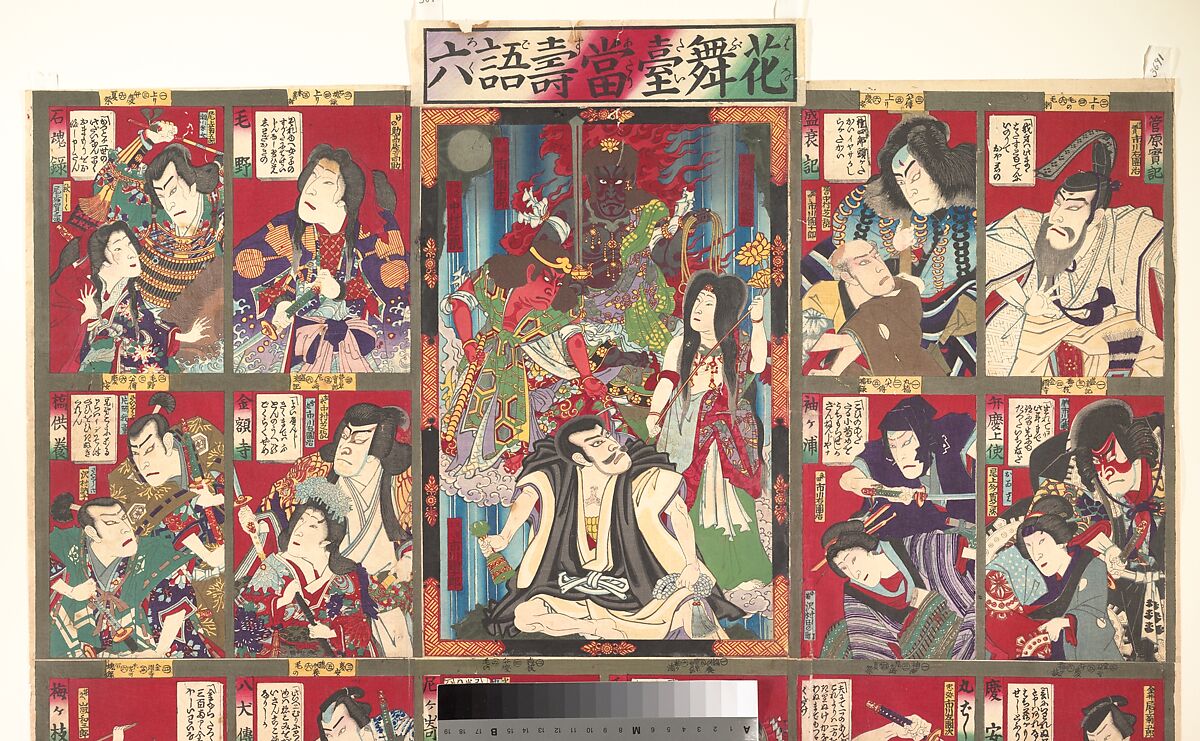
A journey on paper needs a beginning, somewhere to go and a reason to move. Japanese picture board games, or e-sugoroku, made those decisions visible. The National Diet Library describes travel-themed games that offered imagined journeys to people for whom distant travel remained difficult. Their routes could bring familiar place names within reach while arranging them to suit the sheet. The resulting geography was already an interpretation before a player moved a counter. [1]
Consider Sangu kamikyo dochu ichiran sugoroku, which takes a route toward Kyoto via Ise Grand Shrine. The library identifies Nihonbashi at the lower right, Kyoto at the upper right and Mount Fuji near the middle. It describes a bird’s-eye composition that departs from actual geography. That account suggests a useful reading: the sheet organises the anticipation of arrival. Its arrangement is part of the experience, rather than an incidental container for place names. [1]
Scenery makes separate stops feel connected
Tokyo Metropolitan Library’s account of Tokaido saiken sugoroku offers another way of joining a journey together. The design is attributed to Kitao Shigemasa. According to the library, individual post stations appear as landscapes seen from above, with distant mountains creating a sense of continuity. Here the route is not held together by names alone. The repeated landscape treatment helps separate destinations belong to a shared pictorial world, making progress across the sheet feel visually connected. [2]
The library also treats the surviving print as evidence of production. It cautiously places the design around the An’ei to Kansei eras and compares versions carrying different publishers’ names. Its interpretation is that the blocks changed hands and were reused. Those qualifications matter. A printed journey could persist through successive impressions, while the name responsible for issuing it changed. The scenery therefore carries two histories: the route presented to players and the continuing life of the design as a publishable object. [2]
A destination could be an idea
The destination did not always belong to ordinary geography. In their study of Harvard-Yenching Library material, Saranya Choochotkaew and Jingyi Yuan discuss an 1848 Buddhist sugoroku with a manual attached to its reverse. Their reading of that manual identifies a teaching purpose: young disciples were to encounter enlightenment through play and practise reading the names of the spaces. The board’s movement thus organised a sequence of concepts as well as the movement of a playing piece. [3]
The authors also describe pronunciation guides and red annotations that numbered spaces and the outcomes produced by throwing sticks. They suggest that the numbering may have offered a convenient way to find the next move. This is a particularly revealing kind of journey design. Progress depends on translating an outcome into a position, then recognising what that position means. The printed surface and its annotations made that translation possible. In this example, learning the route was inseparable from learning its vocabulary. [3]
What the finish asks players to accept
Duke University Libraries places later sugoroku within the social values promoted through children’s play. Its exhibition explains that games appeared as newspaper and magazine inserts, especially around New Year. The selected examples include savings and aviation themes. Duke interprets them as communicating frugality or admiration for technological achievement. These were routes through an approved set of ideas: the activity asked players to recognise particular subjects as worthy of attention while they competed to reach the end. [4]
The exhibition also examines wartime and colonial boards that promoted Japanese nationalism and claims of military superiority. That context prevents an uncomplicated celebration of every attractive printed route. A game can organise attention around political assumptions as readily as around scenery. Following Duke’s interpretation, the question to ask is what a board makes advancement mean. Where does it direct the player’s interest, and whose view of the world supplies the destination? Reading those choices gives the paper journey its historical depth. [4]
Official sources
Sources were checked on 2026-10-15. These features interpret Japanese print and photographic culture from institutional research. Historical examples do not establish how every viewer responded. The museum images reproduced below have individual credits, rights links and scope notes.
- Famous Places, People, and Social Customs on Paper: Visiting Famous Places — National Diet Library, Japan. Checked 2026-10-15.
- 東海道細見双六 — Tokyo Metropolitan Library. Checked 2026-10-15.
- Sugoroku (双六) Board Games, 1840s–1940s — Harvard-Yenching Institute. Checked 2026-10-15.
- Japan: Celebrating Thirty Years of East Asian Collections — Duke University Libraries. Checked 2026-10-15.