GIZUMO VINTAGE · JAPANESE PRINT & PAPER CULTURE
Surimono and Poetry Made for a Recipient
Privately commissioned prints joined poems, images and skilled production within particular circles of exchange.
Japan; historical paper culture. No contemporary market or visiting guidance.
Editorial feature · Sources checked 2026-10-15 · Credited museum images below
A gift with a particular audience
A print made for a known circle assumes shared references. The Library of Congress describes surimono as privately commissioned sheets combining poetry and imagery, distributed to members of poetry circles, patrons and friends. They often marked New Year. Their intended audience mattered to their construction: the pleasure of receiving one could include recognising a literary allusion or understanding a joke whose meaning was not immediately available to everyone. [1]
The Library’s discussion of a Shinsai print involving cooking icefish stresses this shared cultural knowledge. It also links the care taken by artists, engravers and printers to the sheets’ role as gifts rather than merchandise. The question extends beyond what a print depicts. What relationship does it presume between the person commissioning it and the person receiving it? In this account, the image and poem make that relationship material, preserving an occasion of exchange in a portable form. [1]
Words belong inside the design
RISD Museum explains that, in the classic early nineteenth-century surimono format, poem and image were conceived together. Poetry might address the depicted subject directly or connect through puns and allusions. This changes how the writing should be approached. It is not simply a caption supplying information after the picture has been understood. The recipient has to move between verbal and visual meanings, allowing each to alter the possibilities suggested by the other. [2]
The museum also describes elaborate printing, embossing and metallic materials on substantial paper. Its Osaka-related collection provides a concrete production history: poets and painters sometimes worked with Tani Seiko, who advised on designs and then carved and printed them. RISD’s account makes the gift a collaboration rather than the isolated achievement of the named image-maker. The refinement that reaches a recipient depends on several kinds of judgement, including decisions about how words, marks and printed effects can occupy the same small surface. [2]
Several sheets can hold one conversation
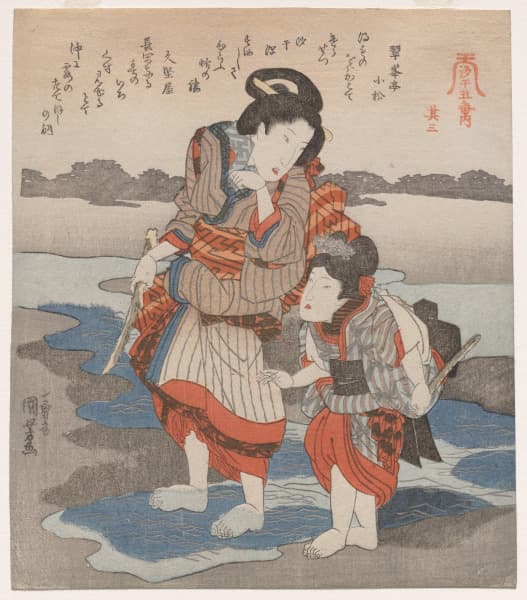
The Cleveland Museum of Art’s Third Print from A Low Tide Pentaptych makes the collective character especially clear. Its record dates the work to about 1830 and attributes the design to Utagawa Kuniyoshi. The museum explains that five surimono together form a beachcombing composition. Ten poems extend across the set, with two on each sheet. The poetry circle was based in Edo and led by Hisakataya Misora, who contributed four of the poems. [3]
Those relationships change the scale at which the work can be read. One sheet is a complete physical object, but the museum’s explanation places it inside a larger arrangement of images and voices. Reading only the single print risks losing that shared structure. The point is not to reconstruct missing verses from appearance; it is to recognise that the surviving unit may be smaller than the original conversation. The set gives a group’s participation a visible organisation, with individual contributions distributed across a connected work. [3]
An album creates another audience
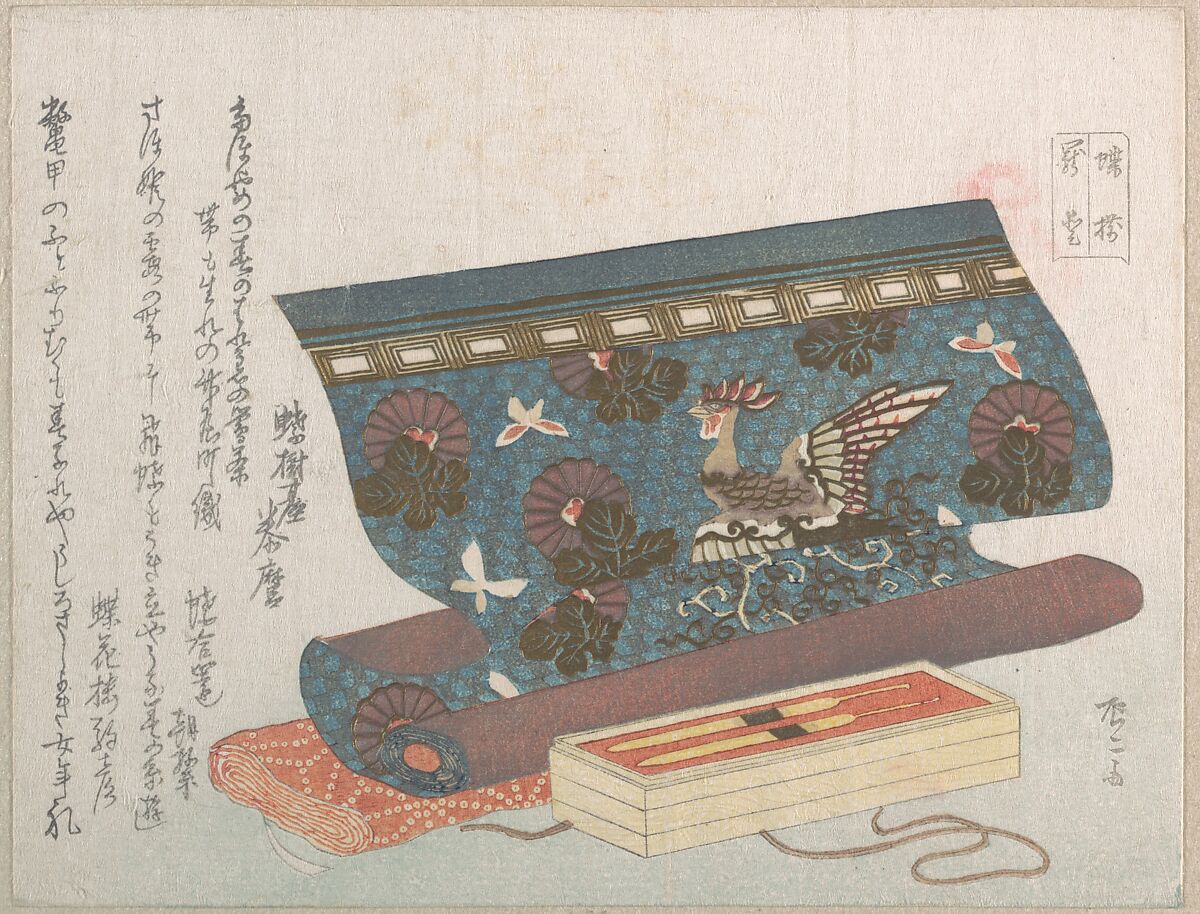
Later collecting could give these intimate prints a different setting. The Metropolitan Museum of Art records a Shinsai design of obi cloth and hair ornaments, dated about 1805–10, within the Spring Rain Surimono Album. The museum identifies the album as part of a three-volume set assembled by the dealer Hayashi Tadamasa. It explains that he arranged more than four hundred prints across facing pages by theme or through complementary shapes and colours. [4]
This later ordering introduces another relationship: the one between neighbouring prints chosen by a collector. A sheet once made for a particular exchange could now be encountered beside a different design because the pair looked or read well together. The Met’s account therefore invites attention to two moments, the production of the print and the assembly of the album. Its present surroundings are meaningful, but they need not reproduce its first social setting. The gift survives, while the act of gathering it creates a new way of reading. [4]
Official sources
Sources were checked on 2026-10-15. These features interpret Japanese print and photographic culture from institutional research. Historical examples do not establish how every viewer responded. The museum images reproduced below have individual credits, rights links and scope notes.
- Images and Literary Sources: The Floating World of Ukiyo-e — Library of Congress. Checked 2026-10-15.
- Surimono from Osaka and Edo — RISD Museum. Checked 2026-10-15.
- Third Print from A Low Tide Pentaptych — Cleveland Museum of Art. Checked 2026-10-15.
- Roll of Cloth for an Obi and Tortoise-shell Hair Ornaments, from Spring Rain Surimono Album — The Metropolitan Museum of Art. Checked 2026-10-15.